Friday, October 22, 2021

Epilogue ARC Progress - battery tray

How and where to install a battery tray can be tricky.  Over the years I've witnessed multiple inflight battery ejections as a result of poor tray design, poor installation execution, or the use of low-grade velcro to secure the battery to the tray. Three basic practices I follow when designing a battery tray are: 1) Secure the tray to the landing gear mount, 2) Secure the battery to the tray using a screw-down locking method, not velcro, 3) Tray must be removable to allow servicing the tray or other components.

The following pictures show the various parts of the tray I designed used on the last three 2m planes,  plus the final installed position.  I use Fiberglass/Honeycomb Sandwich Panels from ACP Composites for the tray floor, locking plate, and circular screw hold-downs.  Another great alternative for the tray floor is balsa/plywood carbon sandwich plates from Esprit Tech.  These materials are much lighter and stronger than traditional lite plywood. that is typically used  The tray floor is attached to graphite tubes using  2-56 screws with blind nuts. The graphite tubes are then secured to the fuselage sides with F3AU's Battery Tray Bracket Kit. Dowel hardpoints are added wherever screws passed thru the honeycomb panel plus reinforced those areas with 1/64th plywood.  Hysol epoxy was used to attach the F3AU bracket mounts to the fuselage.

The tray is fully removable, very strong and durable, and firmly attached to the fuse sides and landing gear formers with a single screw located near the center of the tray floor.  When this screw is tightened the floor rests on the gear mount formers which will prevent the tray from rocking or flexing during inflight G loads. The total tray weight is 58 grams.


Tray Components


Tray Underside

Lockdown Undersides

Tray Location


Saturday, October 2, 2021

Epilogue ARC Progress

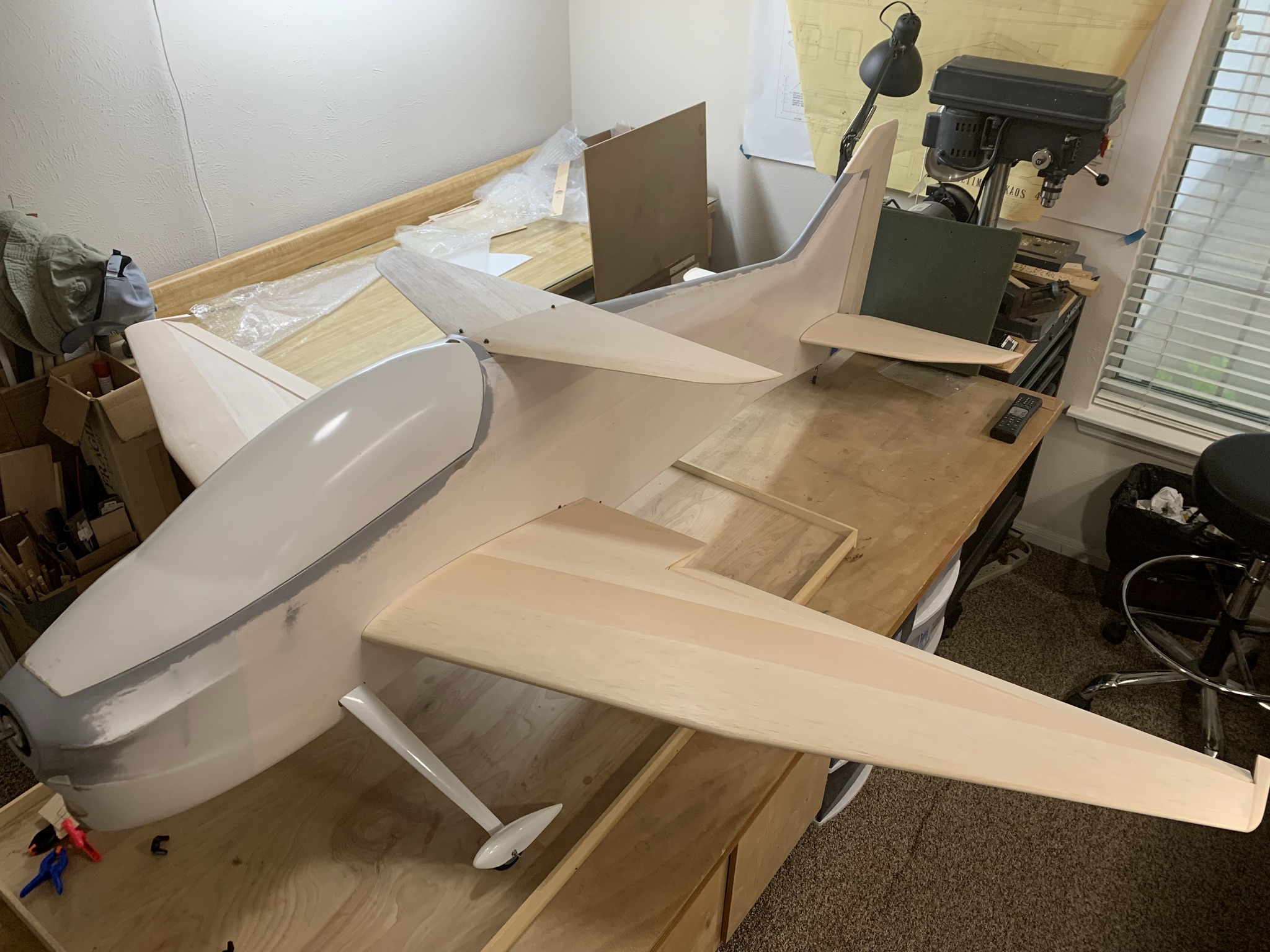
 Epilogue progress:


Scrubbed/washed the fuse to remove mold release. Applied filler and primer to the seam then wet sanded smooth to touch. Fitted servos in the wings and stabs plus the rudder in the fuse for pull-pull. Used the dremel router attachment to route slots in the ailerons, elevators and rudder to accept carbon control horns. I have elected to outfit the wings with traditional balsa tips instead of the supplied carbon wing tip plates.


Next step is to approximate where to position the motor battery tray.  This involves assembly of the airframe components with the motor batteries shifting them fore and aft to determine the cg range of 200 to 260mm measured from the wing’s leading edge. It’s not surprising to have such a rearward cg option with swept wings. Plan is to try using the removal battery tray system marketed by F3AU.


Monday, September 13, 2021

EPIC Evo's first pattern contest

The Fort Bend RC club hosted its third annual pattern contest this past weekend. The weather cooperated for the most part with partly cloudy skies, moderate temperatures, and humidity for September in SE Texas. Winds were direct crosswinds that varied slightly North vs.South all weekend making flight direction pilot's choice throughout the weekend

Leading up to this event I had been working on refining setups on my CA Models EPIC Evo. After redoing the wing and stab alignment and shifting the CG a bit more forward I felt the plane was tracking better in level flight plus up and down lines.  Overall the Evo appeared more locked, especially in windy conditions.  It was time to test its ability in a competitive situation.

In round one I was caught off guard by not flying with enough energy to overcome the crosswind.   The plane was blown-in resulting in making dramatic adjustments to reposition my flight path resulting in score downgrades that were deserved. In the subsequent flights, scores improved by flying with more energy overall.  The D3 Governor is amazing in the way it responds to help manage airspeed during both up and downlines in unfavorable conditions.  Unlike ESC's I've used in the past the D3 there is no need to throttle down as much in windy/crosswind conditions the D3 senses the prop is unloaded in a downline and braking occurs by the governor regulating RPMs relative to the transmitter stick position. The ah-ha moment for me was discovering not having to reduce the throttle as much as I would in more favorable wind conditions. At this higher rpm stick position, braking still occurred on downlines and carry more energy thru a bottom radius.  When establishing level flight the D3 senses the loaded prop and responds by increasing the RPMs relative to the stick position.  The D3 makes it easier to control energy and pace in windy conditions.

It was a successful weekend. I learned a bunch about how to fly in direct crosswinds and power management with the D3 Governor. Despite a slow beginning, I was fortunate to come away with the win.

Fort Bend Contest Results


EPIC Evo details:

  • Radio - Futaba 32MZ / 7108rx
  • Servos - HV digtal
  • Motor - Hacker C54
  • ESC - D3 governor 
  • Prop - APC Carbon 22x13
  • Spinner - Falcon
  • Batteries - motor TP 10s 5000 / RX TP 2s 910
  • Landing gear - Falcon
  • RTF weight - 4756grams


Saturday, August 28, 2021

BJ Craft Epilogue (ARC)

 In May of this year, I took delivery of a BJ Craft Epilogue ARC from F3AU. Upon unpacking the contents I was surprised by the shape of the rudder.  The rudder incorporated a counterbalance similar to my Invitation G2. This was unlike pictures I had viewed of the Epilogue to date online. In addition, there was a nose ring attached to the exterior of the original molded nose ring which had a noticeable change in the right and down thrust amounts. As I continued to unpack components I quickly noted the double taper of the wings and stabs and general location on the fuse were what as I had expected.  Concerned about the rudder shape and nose ring thrust modifications I sent an inquiry to F3AU and BJ Park. The following is the response I received direct from BJ Park about the design changes.

From BJ Craft:

I am BJ Park, owner of  BJ Craft. I am very sorry for giving you trouble and confusion. If you do not like changed design, you can return the plane, the return cost shall be paid to Mike by me. English is not my mother tongue and culture barrier shall be, I may commit indecent act  in the text, please understand and forgive me.

I am going to say about the modification of the design. I have a mistake that I did not inform this to Mike. Sorry for Mike. I am engineer rather than business man, so I commit mistake like this case Especially when I develop new models. please understand this mistake. The reason that I change vertical fin is 3 causes. 

1. The height  of wood crate is determined by the height of the vertical fin. As you know well I ship plans all over the world air shipping by UPS/DHL  Reducing the height of Fin,  wich can save USD600~800/pc. You can see if you check freight in their home page. This is very important element for dealers.

2. Epilogue's counter balance. Feed back from world wide about 1st. lot  production, rudder to aileron mixing is no need or recovery a bit. To reduce recovery, counter balance is,  it  pushes top of the rudder post when you use rudder, due to pushing makes counter recovery roll. It is not  big, reuces mix about 1%.

3. Height of fin in Nuance G2 and Epilogue has higher fin at first lot, that is "new spec" design. this is the spec about design coefficient for aircraft plane form (geometry) which is related with pattern trackng. Epilogue is 2020 versoin of 'new spec" which includes stability (tracking) in 8~10m/sec strong cross wind. 1st  lot  of  Nuance G2  was old version it was 6~ 8m/sec strong cross wind. In the 2nd lot  of  Nuance G2  improved into 2020 version. I realized that feedback from worldwide has a margin to improve. To match 2020 version tail (horizontal, vertical) volume coefficient, vertical fin height of 1st lot Nuance G2 is necessary to highten. This improvement can't  be felt by the fliers who fly the plane in the not srong wind. The improvement that I do in detail may not necessary for the common fliers in worldwide but aircraft designer test and understand those in detail for future technology. The improvement of performance is important but more important is customers' needs.

P.S. : Epilogue in the F3AU pic is the epilogue  prototype which is flown by me WC in 2019. This plane is deigned only for me, my flying style and my propulsion. Drive unit for this plane is 22*16 prop runs at 7000RPM (4000w) this is used only by me in the world. Unique plane makes unique flying possible. unfortunately it needs unique design. Production Epilogue lot was redesigned for common fliers and popular propulsion in the world,even if it is not perfect one but can be satisfied worldwide

The plane perfetly fit to your flying field only is able to be easily designed by me, but your flying field is the micro part of the world, my design is flown in the fields from 0~3000m above sea level, besides this, many elements give effect to the aircraft design. So my design is not perfect  but is stisfied all over the world and prototyhpe and production type is different from each other.

Canalizer for prototype is only one ( wrong design too small) so I changed it into present one. Anhedral for big prop was also deleted. Wing fence in the pic was changed into wing tip fence, which can be easily changed larger or smaller depending on the customer circumstances. Besides these, the moment, wing position ( I like low wing) tail volume etc, etc.

I should have provided the production type picture, due to various reason I couldn't, it was my mistake. Story was long, F3A market is so small that  factory couldn't employ enough workers. But I am doing my best to do all the things as long as I can.


Rudder configuration BJ referenced of his WC 2019 version


Rudder shape of the version I received.


After inspecting the entire ARC kit contents, overall I am very please with the weights, fit and finish like I was with the Invitation G2 ARC.  I've begun working on the Epilogue starting with reinforcement of the gear plate with a Carbon Fiber/Nomex plate with dowel hardpoints for the blind nuts plus installation of the Hacker C54.


Wednesday, August 25, 2021

Future Project

 Future project Angel's Shadow V20 


A nice Texas evening for pattern practice

Yesterday I experienced perfect Texas evening weather.  Light wind down the runway, low humidity a rare occurrence for August. An added plus was having the runway mowed allowing the ability to taxi with my 2" Maxx Prod wheels tucked inside the Falcon wheel pants.

Logged several flights with the EPIC Evo without making changes to setups.  I feel I have the throttle settings/curve on the C54/D3 combo and other flight conditions set to my liking.  Now it's up to me to just fly the plane.


Friday, August 6, 2021

EPIC Evo / Hacker C54 / D3 Update

The Invitation G3/C50/D3 combination served me well at the Texas City contest.  I have not done much flying since then for various reasons.  Wifey and I spent a week in Jamaica, there were multiple days of heavy rain which made the Space City Club runway unusable plus I have been avoiding the late July Texas heat.  Seeking a place to fly in the morning when it's cooler I decided to rejoin the SPARKS RC Club which recently upgraded the runway to a hard surface and is a 10-minute drive from my house.

For the last two weeks, I've been logging air time with the EPIC Evo at SPARKS.  I recently redid the elevator controls to reduce the amount of mechanical travel volume.  I felt the pitch response was difficult to manage due to flying with more exponential than I prefer to use. This helped but I still felt there was room for improvement. Pushing into and out of vertical lines plus elevator input during rolls and inverted flight segments was inconsistent.  A friend and fellow pilot suggested to aggressively move the motor battery forward by an inch or so.  This dramatically changed the pitch feel.  In the flights that followed I began sliding the battery incrementally back towards the original position until I achieved the desired pitch response I was after. This confirms recommended CG position by the designer is simply that, a recommendation. One must experiment with the CG position to their particular flying preference.

The EVO now feels very comfortable, now it's a matter of logging practice time on the Evo to adjust to the different visual queues it presents and fine-tuning flight conditions to my liking.  Overall I am very pleased with this design and selected power system.

EPIC EVO

  • Motor: Hacker C54 2Y L
  • ESC: Debowski D3
  • Battery: TP 10S 5000mAh
  • Prop: APC carbon 22x13
  • Radio: Futaba 32MZ, HV servos
  • Landing gear: Falcon gear and pants
  • RTF weight: 4756gr

SPARKS Runway


EPIC Evo


Thursday, July 1, 2021

Air Plane Rack Update - Honda Odyssey

 The new airplane rack in the old Odyssey works great.  It comfortably accommodates 2-2m fuselages equipped with canilizers.  The cradle on the right is a different height to enable planes with anhedral stab configurations. Since the contest trip, last weekend was just across town, I elected to lay the wings on the floor although they can fit up off the floor on either side of the fuselages to provide ample floor space for support equipment, etc. The rack is easily removed to covert the cargo area to haul whatever including people and storable in the garage. Very happy with how the rack turned out.


Sunday, June 27, 2021

Texas City Contest

This weekend I competed in the Texas City Pattern Classic.  I understand the last pattern event the club held was 30 years ago.  Their facility is perfect for pattern along with the club's energy and support for hosting a first-class event is second to none. 

I've been flying with and coaching  Justin Wells who is preparing for the 2021 Nats.  Helping him has rejuvenated my pattern spirit.  I am practicing and focused again on airplane equipment preparation, trimming/setup, and practice.   This weekend's event demonstrated I am still competitive in Masters at least in D6.

As a Futaba Field Rep, I always have an ear out for radio comments from users.  Futaba continues to be the dominant brand in this part of the country.  Because of the integrated telemetry with their ESC's and recorded voice playback options a few have migrated over to Jeti.  The next popular radio would be Spectrum, JR and Airtronics are pretty much non-existent.  Propulsion systems, contra drive systems have become very popular among competitors in all classes.  For the most part, the Adverunn is what I see the most of, then Brenner's system.  For me, the Hacker geared inrunners C50 and C54 is what I continue to use. Pairing these motors with Adam Debowski's D3 swinging an APC carbon 22x13 is an ideal power system in my Invitation G2 and Epic + and Evo.  The invitation served me very well this weekend at the Texas City event.

Texas City Contest Results


Here are a few pictures from the Texas City event: